
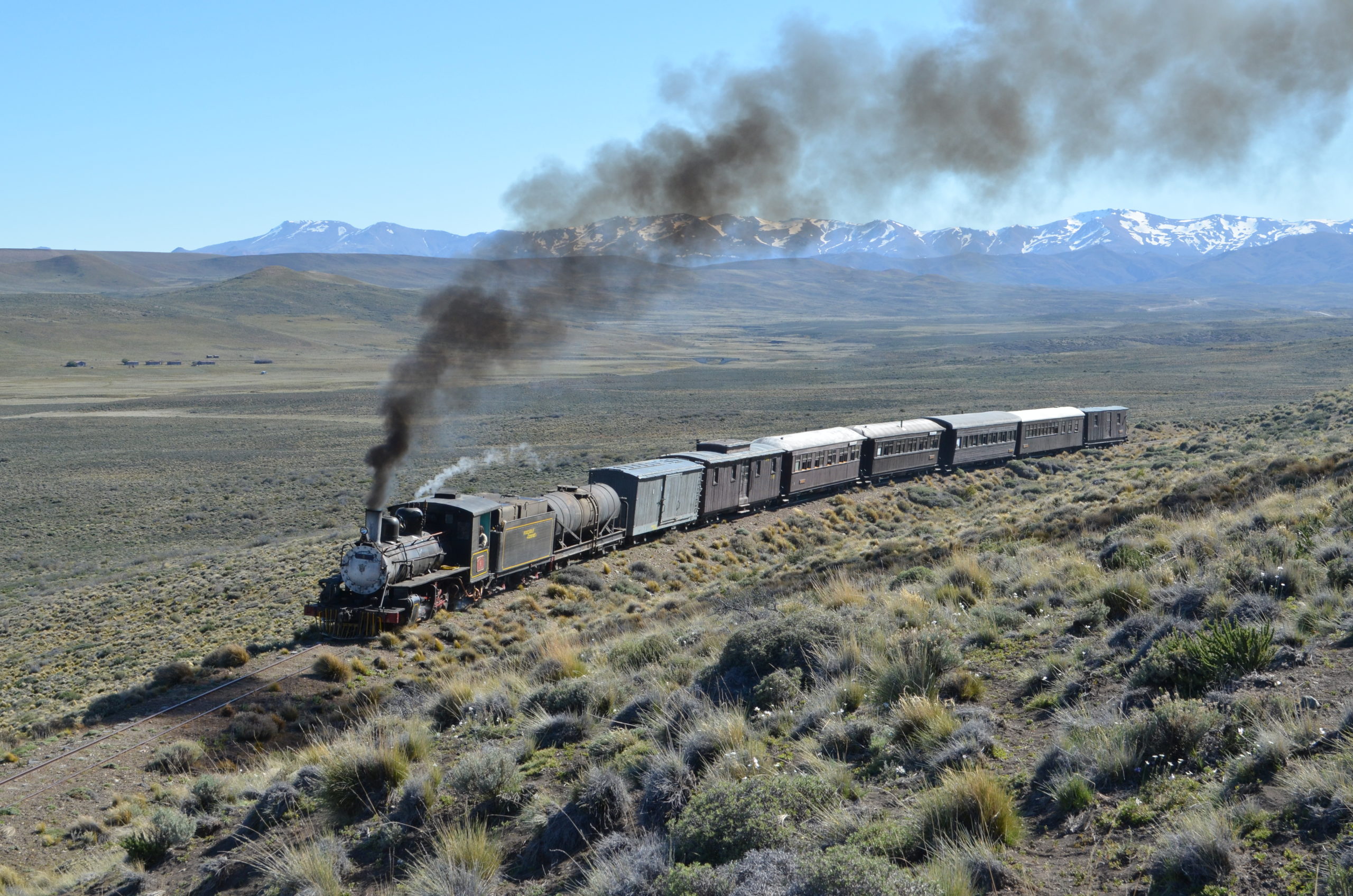
One of the most amazing railways in the world today is Argentina’s famous narrow gauge railway in Patagonia. With a gauge of 750mm ( 2 feet 5 ½ inches ) the 402 kilometre long line is now open over the complete length. There are no regular trains, but Tourist runs operate out of Esquel at the southern end, El Maiten in the middle and Ingeniero Jacobacci at the northern end. These run out and back for 2-3 hours.
There are also occasional charters and in October 2014, I was able to join Bernd Seiler with Farrail Tours and a group of 50 railfans – mostly German, Swiss and French – a few English and one Aussie. Over eight days we covered almost the entire 400km with a variety of locos and consists and lots of photo stops.
Railways in Argentina began with a British Company in 1855 and by 1914 the 5 foot 6 inch network was the tenth largest in the world reaching 47,000 km by 1945. Many of the private companies were British owned. In 1948 President Peron nationalised the network into six independent divisions and in 1993 the system was again privatised. Many lines have been closed and services dramatically reduced in the face of airline and road competition.
Following the First World War the Argentine Government looked at opening up the vast area of Patagonia with a network of narrow-gauge railways and in 1921 agreement was reached to construct a 400km line from Ingeniero Jacobacci to Esquel. Other lines were planned. Popular reading suggest that the railway used second-hand equipment from the First War, but everything I saw was made in the 1920s. Much equipment was ordered, including rail, carriages and freight trucks from Belgium and 82 steam locos.
Most of the locos were a 2-8-2 design and oil fired. The initial order was with Henschel in Germany for 50 locos, but delivery was slow, so a further 25 were ordered from Baldwin. Amazingly Baldwin built their 25 locos in 40 days! Although to the same specification, there were a number of variations. The Baldwins had round-topped fireboxes, the Henschels Belpaire. The Baldwins had dome sandboxes, the Henschels on the running board ( although some later gained sandboxes off Baldwins ). The Henschels had inside frames, the Baldwins outside. The Baldwins had flanges only on the leading and trailing driving wheels – the Henschels on all eight. The tenders on the Henschels were surprisingly small with rail extensions – not much use with oil!
The engines weigh 50 tonnes with a driving axle load of only 5 tonnes. Tractive effort is 10,400 lbs. Driving wheels are 800mm diameter ( 2 feet 71/2 inches ). Maximum speed is 50 km/h.
In addition Henschel also supplied four small tank engines and three crane tank locos. One of the tank locos was at El Maiten, though not operational.
First trains ran in 1935 with El Maiten reached in 1941 and Esquel in 1945. The railway was busy until the 1970s when road competition began to erode business and regular services finished in 1992. The two provincial Governments have responded to public pressure by keeping the railway operational. Today there are eight operational locos, depots at Esquel, El Maiten and Jacobacci and more than 60 staff. Given that fewer than 20,000 passengers a year are carried, the future of the whole line must be uncertain, but Tourist services will continue on local sections, most likely in the Southern Zone.
The track was surprisingly good and at times we rattled along at up to 50km/hour with a good ride – enjoying a cold beer in the dining car was possible! Interestingly I saw no sign of any trackwork having been recently completed. Rail is 18 kg on timber sleepers. From the engine the rails were invisible under grass on some sections and slipping was frequent.
We stayed in hotels at Esquel, El Maiten and Jacobacci and although the meals were limited the accommodation was quite good. The week before my visit temperatures had been hovering around 5C, but during our week we had sunshine every day and temperatures up to 25C.
Much has been written about ‘La Trochita’ but I strongly recommend a visit. The only practical option if you wish to see more than 20km, is with a Tour Group and in 2014 there were only two – Farrail and Railway Touring Company. With only a half-inch gauge difference one of the locos could run nicely on ‘Puffing Billy’……
What is so appealing is that the train is hardly modernised and retains a 1950s feeling. Australian Safety Standards have not yet reached Argentina so you can still sit on the end platform and soak up the atmosphere.
Jeremy Browne
Adelaide, South Australia
December 2014