
From 1961 to 1964 my father was posted to Adelaide and as a young railfan I traded New Zealand’s Abs and Ks for South Australian 500s and 520s. One of the conditions of his job was leave in England every two years and in late 1961 and early 1964 we sailed to England on board the “Himalaya” and “Canberra”. In those days P & O had weekly sailings from Australia.
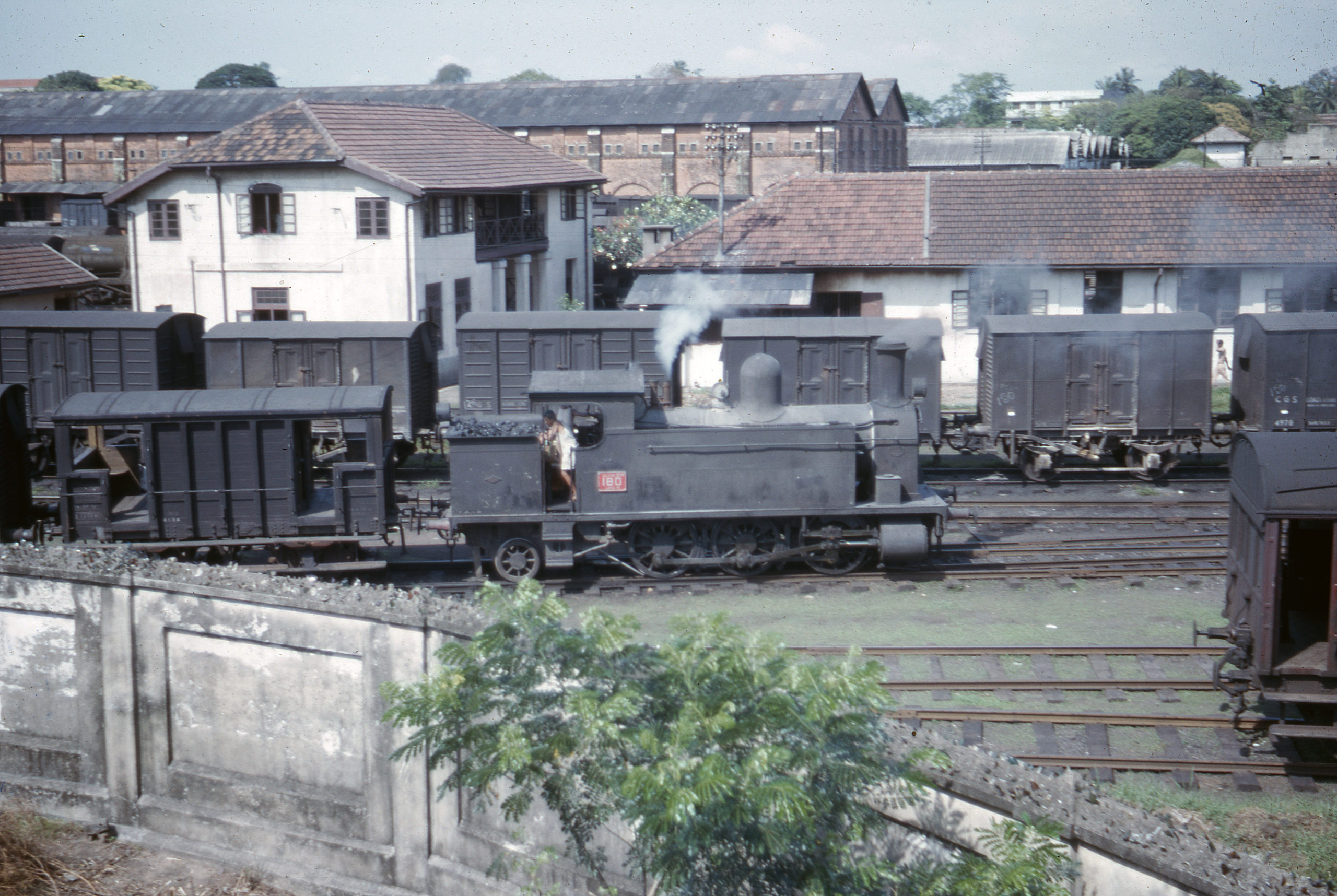
In 1961 I had made a brief visit to Colombo Fort Station during our day ashore in Ceylon ( now Sri Lanka ) and seen broad gauge ( 5 feet 6 inches ) and narrow gauge ( 2 feet 6 inches ) so when we docked for a twelve hour stopover in 1964 I was ready to see more. After a tourist family outing by taxi, I borrowed my father’s camera and set off along the track to the loco sheds at Maradana Junction, a kilometre or so along the line. Looking at Google Earth the covered overbridge, loco shed and turntable are still there!
It seems amazing today that at 16 years old I could wander off alone walking along the railway line…
Ceylon Railways were mainly broad gauge, but there was a small narrow gauge system which was converted or closed in the 1990s. Although diesels had started to arrive there was still plenty of ancient steam and the depot at Maradana was a busy place, with no condemned rows. Almost all of the steam fleet was built in England by various builders, the largest class being 49 of the B1 class 4-6-0s. There were 21 A class 4-8-0s but I did not see any.
The staff at the depot were bemused by the young railfan and happily moved locos out for me to photograph, although the sole narrow gauge Garrett was stuck in the shed and in those days a tripod was beyond my budget.
Jeremy Browne


